
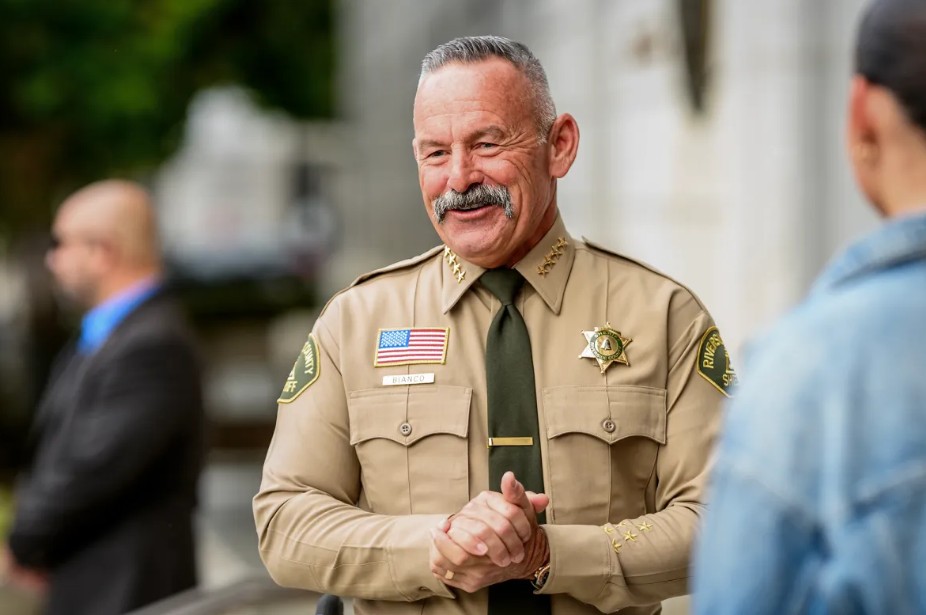
The California Supreme Court has unanimously ordered Riverside County Sheriff Chad Bianco to return approximately 650,000 ballots that his department seized during an investigation into alleged voting irregularities, ruling that the operation violated state election law.
The September 24 decision resolves a major legal confrontation over who has the authority to possess and examine voted ballots in California and establishes clear limits on law enforcement access to election materials.
The dispute originated with California’s November 2025 special election on Proposition 50, a congressional redistricting measure that passed statewide and also won in Riverside County.
Bianco’s department seized the ballots in early 2026 after a local activist organization raised concerns about apparent discrepancies between the number of ballots received and counted. The sheriff maintained that his department was conducting a legitimate criminal investigation and had obtained search warrants authorizing its actions.
Election officials disputed the underlying allegations.
Riverside County Registrar of Voters Art Tinoco said officials had examined the claimed discrepancies and determined that the activists’ analysis was misleading because it did not properly account for the process used to verify ballots before they are counted. No fraud was established from the allegations that prompted the investigation.
The California Supreme Court did not accept Bianco’s argument that search warrants allowed his department to remove the ballots.
Chief Justice Patricia Guerrero, writing for the court, emphasized that California election law specifically protects voted ballots by restricting who may handle them and requiring them to remain under the physical control of election officials.
The court pointed to Section 15551 of the California Elections Code, which states that voted ballots cannot be removed from the custody of the responsible elections official, even when a court authorizes their inspection.
According to the ruling, Bianco’s seizure therefore violated the law regardless of his stated investigative purpose.
The justices also expressed broader concerns about election integrity. The court reasoned that allowing law enforcement agencies unrestricted access to ballots — including the ability to handle or count them under procedures outside established election rules — could itself create risks to public confidence and ballot security.
Bianco has defended his actions and rejected accusations that the investigation was politically motivated. He has argued that his department was attempting to determine whether allegations of irregularities had merit and criticized legal efforts to stop the investigation.
The case attracted additional attention because Bianco, a Republican, was also running for governor of California during the controversy. His political status intensified scrutiny of the investigation, although the court’s ruling focused on the legality of the ballot seizure rather than determining Bianco’s political motives.
California Attorney General Rob Bonta had challenged the sheriff’s actions, arguing that election law did not permit Bianco to take possession of the ballots. Governor Gavin Newsom’s administration also opposed the seizure, and California subsequently enacted legislation designed to prevent unauthorized removal of election materials.
Under the Supreme Court’s order, the seized ballots must be returned to the Riverside County registrar, and Bianco must stop handling them except as necessary to comply with the ruling.
The decision could have consequences beyond Riverside County.
Election officials nationwide are confronting increasing disputes over voting procedures, ballot custody and allegations of election irregularities. California’s highest court has now established a clear principle within the state: even a law-enforcement investigation supported by a search warrant does not override statutory protections governing custody of voted ballots.
The ruling therefore represents both a resolution of an extraordinary local dispute and an important clarification of the boundary between criminal investigations and election administration in California.