
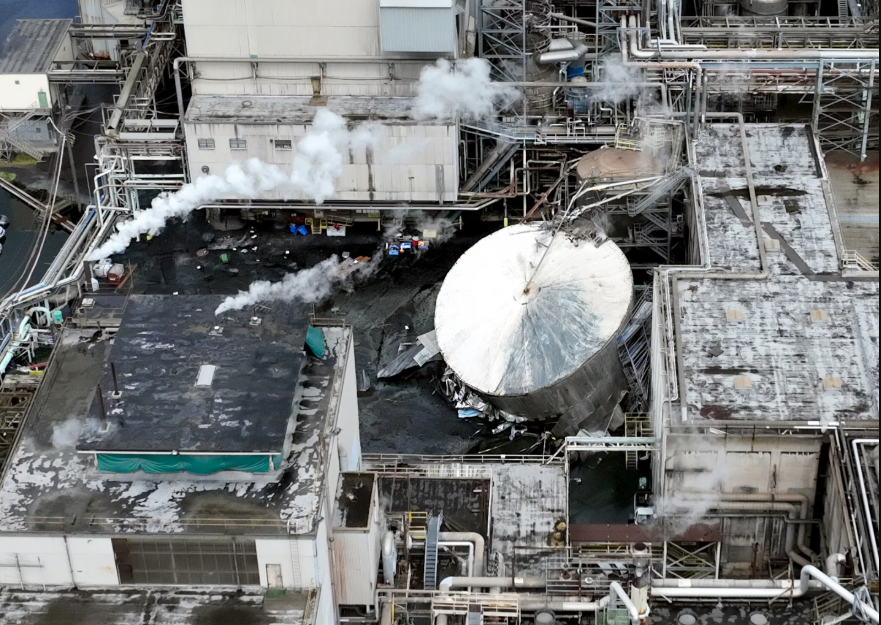
A devastating paper mill explosion in southwest Washington has become an emotional and political backdrop to one of the most closely watched U.S. House races of the 2026 midterm elections.
In May, an explosion at the Nippon Dynawave Packaging mill in Longview killed 11 workers, making it one of Washington state’s deadliest industrial accidents in a century. The tragedy deeply affected a community whose economy and identity have long been tied to heavy industry, logging and paper manufacturing.
Longview sits inside Washington’s 3rd Congressional District, where Democratic Representative Marie Gluesenkamp Perez is fighting to keep her seat against Republican state Senator John Braun.
The race is particularly significant because the district has become a symbol of the broader struggle for working-class voters.
Gluesenkamp Perez first won national attention by capturing the seat in 2022 and has built her political identity around a centrist, blue-collar image. She has frequently broken with other Democrats on issues including immigration, federal spending and some cultural debates, arguing that her district requires a more pragmatic approach.
That independence has helped her compete in a politically divided region, but it has also created tensions with progressive Democrats who believe she has moved too far toward conservative positions.
Braun, meanwhile, has presented himself as a more traditionally Republican alternative and finished ahead of Gluesenkamp Perez in Washington’s August primary. The general-election contest remains highly competitive, with recent polling data essentially tied and only a small share of voters still undecided.
The mill explosion has not been aggressively politicized by either candidate.
Both campaigns have been cautious about turning the deaths of local workers into a partisan issue, reflecting the sensitivity surrounding the tragedy.
Gluesenkamp Perez, however, has received attention for her response after the disaster.
She worked to preserve funding for the federal Chemical Safety and Hazard Investigation Board, an independent agency responsible for investigating serious industrial chemical accidents. Supporters have pointed to that action as an example of how federal institutions can directly affect working communities such as Longview.
The broader political debate extends well beyond workplace safety.
Residents interviewed in the district expressed concerns about wages, job stability, immigration, government spending and whether traditional industries can survive economic and technological changes.
Those pressures are particularly visible in places like Longview, where industrial jobs have historically provided stable middle-class incomes but have become increasingly vulnerable to automation, global competition and corporate restructuring.
For Gluesenkamp Perez, the challenge is maintaining support from working-class voters while remaining part of a Democratic Party that many rural and industrial communities increasingly view with skepticism.
For Braun, the opportunity is to capitalize on dissatisfaction with national Democratic policies while convincing voters that Republican leadership would better protect local industries and jobs.
The Longview tragedy adds a human dimension to those larger questions.
The deaths of 11 workers are a reminder that debates about industrial policy, regulation and economic security are not abstract for communities built around manufacturing.
The race therefore reflects a broader national political divide: both parties are competing to demonstrate that they understand working-class Americans, but voters remain deeply skeptical of political promises.
As Election Day approaches, Washington’s 3rd District is becoming more than a contest between two candidates.
It is also a test of whether a centrist Democrat can continue winning in a politically divided, industrial region — and whether local economic anxiety and shared tragedy will ultimately outweigh national partisan loyalties.