
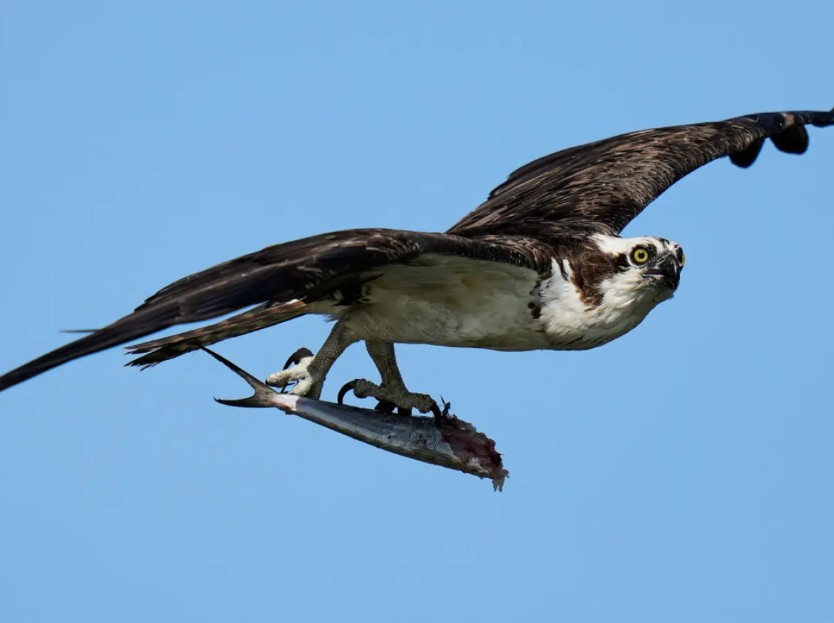
One of America’s most celebrated wildlife recoveries is facing a troubling reversal as ospreys struggle to reproduce along large portions of the East Coast, with scientists increasingly focusing on shortages of a small but ecologically important fish as a major factor.
Ospreys were once devastated by the pesticide DDT, which caused eggshell thinning and contributed to dramatic population declines during the 20th century. After DDT was banned in the United States in 1972, the birds staged an extraordinary comeback.
Now researchers are seeing another alarming change.
Scientists from William & Mary’s Center for Conservation Biology examined 2,886 osprey pairs across 65 study areas in 10 Atlantic states during the 2026 breeding season. Their findings revealed a striking divide between coastal and freshwater populations.
Only 28% of saltwater study areas produced enough young to sustain their populations, compared with 93% of freshwater locations.
The Chesapeake Bay is experiencing the most severe problems.
Researchers recorded the worst osprey breeding season they have ever documented there, finding starving chicks and numerous nests producing few or no surviving young. In some saltier portions of the Chesapeake, reproduction has fallen dramatically below the level required to maintain a stable population.
The decline is also spreading geographically.
Poor reproductive performance has been documented from the Chesapeake through Delaware and New Jersey and into Long Island and southern New England.
Scientists increasingly suspect that Atlantic menhaden are central to the problem.
Menhaden are small, oily schooling fish packed with fat and calories. They are particularly valuable to ospreys raising chicks because they provide substantially more energy than many alternative prey species.
They are also critical to the broader marine ecosystem.
Striped bass, bluefish, whales and seabirds consume menhaden, while commercial fisheries harvest them for bait, fishmeal and fish oil.
Researchers have found that in parts of the Chesapeake, delivery of menhaden to osprey nests has fallen by more than 80% since the 1980s. As ospreys substitute other fish, the energy content of their diet has declined by roughly half.
Exactly why menhaden availability has changed remains disputed.
Scientists are investigating commercial fishing, changing ocean and estuary conditions, migration patterns and timing. In some recent years, large schools of menhaden have arrived after the period when osprey chicks require the greatest amount of food.
Commercial harvesting has nevertheless become the center of an increasingly contentious debate.
Virginia receives roughly three-quarters of the Atlantic Coast menhaden quota, and most of the state’s allocation goes to the reduction fishery supplying Omega Protein’s processing facility in Reedville. Its supplier, Ocean Harvesters, caught nearly 300 million pounds of Atlantic menhaden in 2024.
Conservation organizations and recreational fishing groups argue that more menhaden should remain in Chesapeake waters to support predators including ospreys and commercially valuable game fish.
The fishing industry disputes claims that commercial harvesting is responsible for the osprey decline. Omega Protein and Ocean Harvesters argue that scientists have not demonstrated a direct causal connection between their fishing operations and local shortages.
Federal scientists are continuing to investigate that question. The U.S. Geological Survey is comparing historical and contemporary data on osprey reproduction, diet and menhaden availability to determine whether food shortages or other environmental factors are driving the decline.
The situation is especially striking because ospreys have long symbolized successful environmental recovery.
Their disappearance from coastal nesting areas therefore represents more than a problem for a single bird species.
Ospreys may be acting as indicators of a larger disruption in the Atlantic food web — revealing how changes affecting one small fish can ripple upward through an ecosystem that depends on it.